 English
 Български
White Hat vs Black Hat SEO: What's Allowed and What Gets You Penalized
Black hat SEO is any tactic that tries to trick search engines rather than earn rankings. It can work for a while. Then a spam update or a manual review takes away the gains, and sometimes the whole site’s visibility with them. This guide explains what Google currently allows and what it bans, using its own spam policies and real examples from sites we’ve audited. It also covers what happens if you get caught, and the questions to ask before hiring anyone to do SEO for you.
What Is Black Hat SEO?
Black hat SEO is the use of tactics that break search engine guidelines to manipulate rankings. Examples include buying links, mass-producing low-value pages, hiding text, and showing search engines different content from visitors. The term comes from old Western films, where villains wore black hats.
What Is White Hat SEO?
White hat SEO is ranking by making your site genuinely better: useful content, a technically sound site, and links and mentions earned because people find your work worth referencing. It follows Google’s guidelines. It’s slower to show results, but those results last.
White Hat vs Black Hat vs Grey Hat at a Glance
 Three approaches to SEO, from what Google recommends to what it penalises
| White hat | Grey hat | Black hat | |
|---|---|---|---|
| Links | Earned through content, PR and relationships | Paid guest posts, link exchanges | Bought links, private blog networks |
| Content | Original and helpful | Lightly rewritten or copied sections | Mass-produced, spun or scraped pages |
| Reviews | Asked for from real customers | Incentivized reviews | Fake or bought reviews |
| On-page | Clear titles and natural keywords | Over-optimized anchors and titles | Hidden text, keyword stuffing, cloaking |
| Risk | Low | Medium, and growing | High: demotion or removal |
Black Hat Tactics Google Explicitly Bans
Google’s spam policies list the tactics that can get a site demoted or removed from search results. These are the ones businesses run into most often.
 Link schemes and other manipulation break the moment Google catches them
Buying and exchanging links
Any link given in exchange for money, products or a link back counts as a link scheme if it’s meant to pass ranking value. Paid links are allowed only when they’re marked with rel="sponsored" or rel="nofollow". Private blog networks (PBNs), groups of sites built only to link to each other or to clients, fall into the same category.
Scaled content abuse
Since March 2024, Google has explicitly targeted “scaled content abuse”: producing large numbers of pages mainly to rank, rather than to help people. It doesn’t matter how the pages are made, whether by AI, by spinning existing articles, or by stitching together scraped content. The problem is the intent and the lack of value.
Site reputation abuse
Sometimes called “parasite SEO”, this is publishing third-party content on a respected website to borrow its ranking strength. A typical example is a news site hosting unrelated coupon or payday-loan pages. Google added this to its spam policies in 2024.
Expired domain abuse
Buying an expired domain with a strong history and filling it with unrelated, low-value content to take advantage of its old reputation. Also added in 2024.
Cloaking and sneaky redirects
Showing search engines different content from what visitors see, or sending visitors somewhere other than the page Google indexed.
Hidden text and keyword stuffing
White text on a white background, text hidden off-screen, or keywords repeated unnaturally to influence rankings. These are old tactics, but they still turn up.
Doorway pages
Many near-identical pages built to rank for slight variations of a search, like hundreds of “plumber in [town]” pages with only the town name changed, all funneling visitors to the same place.
Fake reviews and review manipulation
Fake reviews break Google’s policies and, in the US, the Federal Trade Commission’s 2024 rule banning fake reviews. They’re also easier to spot than people think. On one business-to-business site we audited, every displayed review was five stars across five categories, with very similar wording. Even if those reviews are genuine, they look manufactured to customers and to anyone checking. Only showing reviews you’ve filtered for positivity carries similar risks.
The Grey Area: Risky but Common
Some tactics aren’t spelled out as clearly, but they carry real risk:
- Paid guest posts without
rel="sponsored". If money changes hands for a link, it’s a paid link, whatever it’s called. - Link exchanges. “I’ll link to you if you link to me”, including “triangular” exchanges through a third site, is still a link scheme when done to manipulate rankings.
- Copied content. On one store we audited, the FAQ page had been copied word for word from an unrelated supplements brand. That’s not a penalty by itself. Google usually just ignores duplicates. But it adds nothing, confuses visitors, and is a clear quality problem.
What Happens If You Get Caught
Algorithmic demotion vs manual action
Most spam is dealt with automatically. Google’s systems, including SpamBrain, detect patterns and simply stop counting the manipulated signals, or demote the pages. You won’t get a notification. Rankings just fall, often after a spam update.
A manual action is different. A member of Google’s team has reviewed the site and found a violation. You’ll see it in Google Search Console, under Security & Manual Actions → Manual actions. Google’s help page for the report explains each type of manual action.
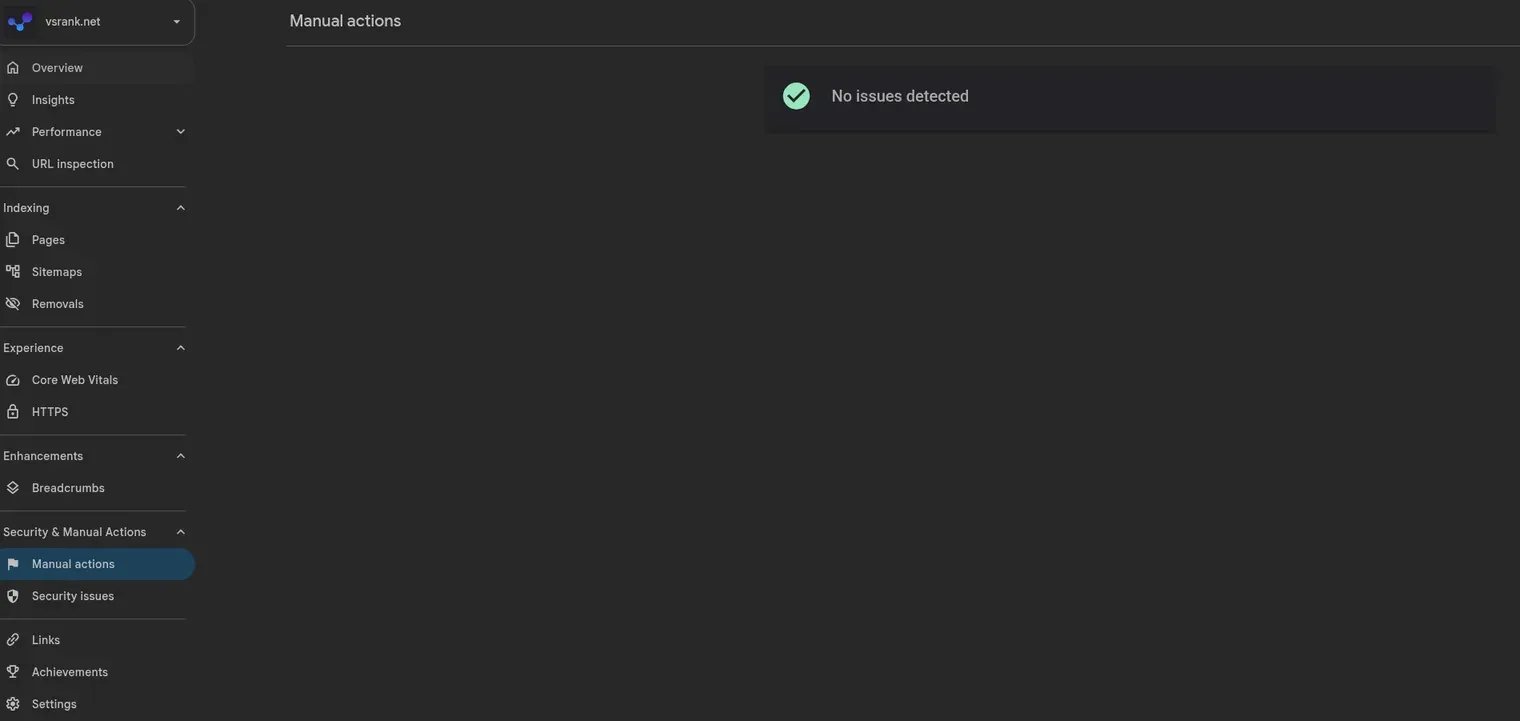 A clean Manual actions report: this is what you want to see
How to recover
- Find the cause. Check the Manual Actions report and review any recent tactics, including anything a past agency did.
- Fix it completely. Remove paid links (or mark them
rel="sponsored"), delete or improve spammy pages, take down fake reviews. - Document what you did. Record which links were removed or disavowed, and which pages were changed.
- Request a review (for manual actions). Use the reconsideration request in Search Console, explaining the problem, the fix and the evidence.
- Be patient. Reviews take days to weeks, and recovering rankings can take longer.
When to use the disavow tool
Rarely. Google’s disavow tool tells it to ignore specific links. It’s meant for sites with a manual action for unnatural links, or a clear, large pattern of spammy links you built or bought and can’t remove. Most sites never need it.
Negative SEO: When Someone Else Does It to You
Negative SEO means a competitor or a bot pointing spammy links at your site to harm it. It sounds frightening, but Google says its systems are good at ignoring this kind of link.
 Negative SEO is rare, and Google ignores most spammy links pointed at you
In one audit, we found a site whose referring domains jumped by roughly 200 in a single month and then vanished just as quickly. Spikes like that are usually automated spam that comes and goes. Monitor your backlinks, and don’t panic. Disavow only if a manual action appears.
7 Questions to Ask Before You Hire an SEO Provider
- How will you get links? Look for content, PR and outreach. “We have a network” is a red flag.
- Will any links be paid for? If yes, they must be marked
rel="sponsored". - How do you create content, and who reviews it?
- Will you create pages in bulk, such as city or keyword variations?
- Do you guarantee rankings? Nobody can guarantee rankings in Google.
- Can I see examples of your work and results?
- What happens to our site if we stop working together? White hat results should last. Black hat results often collapse.
The Bottom Line
The line between white hat and black hat SEO comes down to one question: are you making your site better for people, or trying to fool a ranking system? Google’s spam policies have become more specific since 2024, and its systems are better at spotting manipulation at scale. Shortcuts carry more risk than ever. Sustainable rankings come from the same things that win customers.
If you’d like a team that only uses white hat methods, see our SEO services. For more on earning links the right way, read our guide to link building. This article is part of our complete guide to SEO for business.
About the author: Valentin Staykov is the founder of VS Rank. A software developer since 2020 and an SEO specialist since 2024, he has worked with local service businesses, e-commerce brands, an interior design studio and SaaS companies. More about Valentin.


